Table of Contents
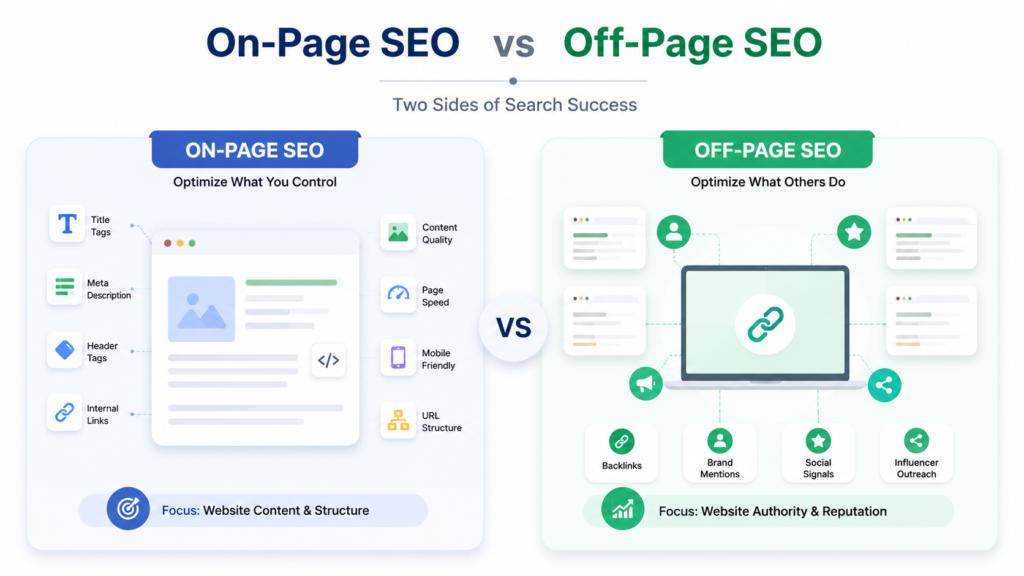
If you’ve spent any time researching how to rank higher on Google, you’ve almost certainly run into the debate around on-page SEO vs off-page SEO. Some marketers swear that content and technical optimization win the game. Others insist backlinks and brand authority are what actually move rankings. The honest answer is less dramatic than either camp wants it to be: both matter, but they matter differently depending on where your website stands today.
This article breaks down what each one actually means, how they work together, and how to decide where to put your effort first — without the vague “it depends” non-answers that dominate a lot of SEO content online.
What Is On-Page SEO?
Internal links
Page speed and Core Web Vitals
If the website works well on phones
Image alt text and making image files
URL structure
Since these parts are all up to you, on-page SEO is often where people who are just starting out begin. That is a choice. According to Googles Search Central information the quality of the content and how relevant it is are still the things when it comes to how pages are judged and shown in search results.
What Is Off-Page SEO?
Shares and signals – when people share your content through media
* Citations and listings – when your website appears in directories
* Guest blogging and digital PR – when you write and are published on websites
* Reputation and review signals – when people make statements about your website
* Partnership with influencers or representatives of your industry
As we can see, off-page SEO is quite uncontrollable, since it depends on what others do. They may talk about your brand; they may provide backlinks. However, you have no control over this matter. However, off-page SEO is significant for search engines because it makes search engines perceive your website as reliable.
The concept of off-page SEO covers all actions that occur outside the website and influence the perception of its authority and trustworthiness by search engines. Probably the most well-known off-page SEO action is backlinking. Backlinks are links from websites that lead to your website. Additionally, off-page SEO includes brand mentions that refer to the mentioning of your brand despite the absence of links.
The real difference between On-Page SEO vs Off-Page SEO
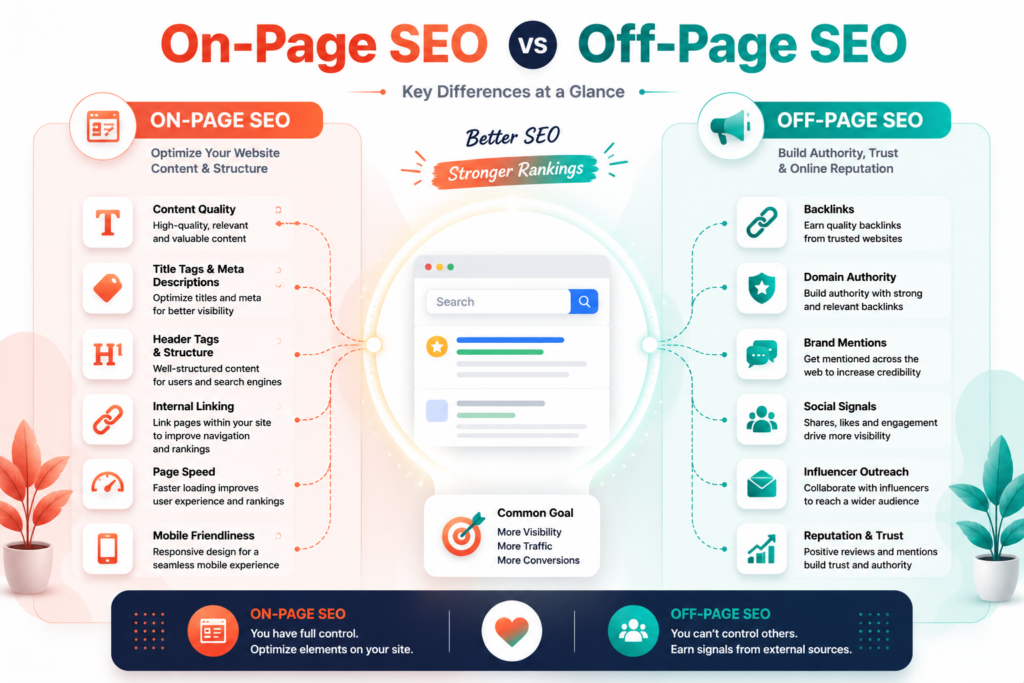
On-Page SEO and Off-Page SEO are different in ways.
The big difference between On-Page SEO and Off-Page SEO is what sets them apart.
Let us look at On-Page SEO and Off-Page SEO to understand them better.
When we talk about On-Page SEO we have control over On-Page SEO because On-Page SEO is on our website.
On the hand Off-Page SEO is not something we can control easily or we can only control Off-Page SEO indirectly.
Our main focus for On-Page SEO is the content of our website, the structure of our website and the technical part of our website.
For Off-Page SEO we focus on building authority, trust and reputation of our website.
If we want to make changes On-Page SEO can be implemented quickly.
Off-Page SEO takes a lot of time to implement.
Some examples of On-Page SEO are tags header tags and site speed of our website.
For Off-Page SEO we have backlinks, citations and public relations to consider.
The level of risk is also different for On-Page SEO and Off-Page SEO.
On-Page SEO has some risk because we control everything about On-Page SEO.
Off-Page SEO has a risk because we do not have complete control over Off-Page SEO.
On-Page SEO and Off-Page SEO are two things and we need to understand the differences, between On-Page SEO and Off-Page SEO to make the most of On-Page SEO and Off-Page SEO.
Which Matters More in 2026?
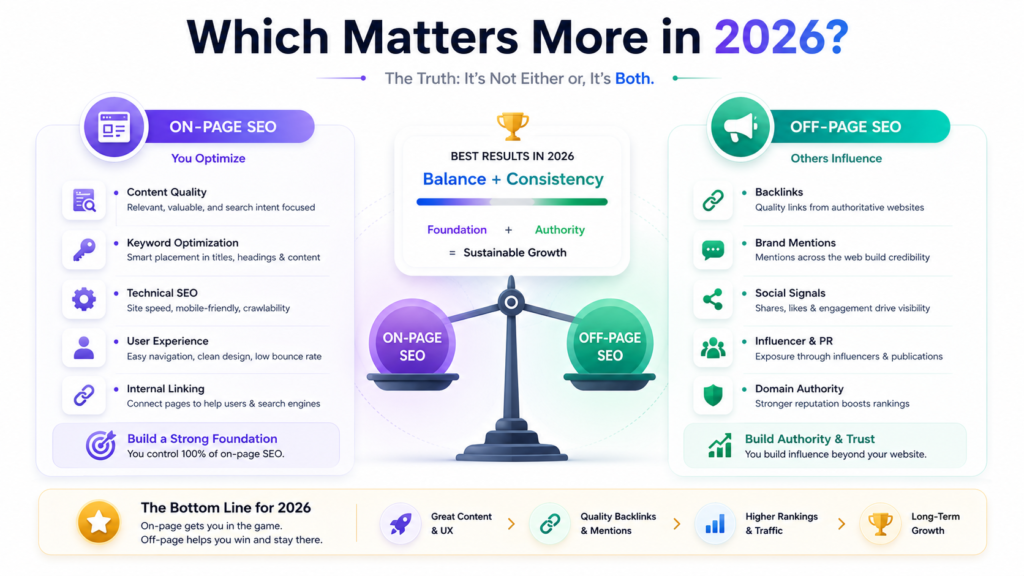
This is where most people do not give an answer. I will tell you a simple way to think about it.
If your website is new or it has foundations. Like it does not have a lot of good content or it is not organized well or it takes a long time to load. Then things you do outside of your website like getting other websites to link to you will not work very well no matter how many links you get. Search engines need your website to be good and work well so it can actually show up in search results when people start to see it as important.
If your website is already good and has basics but it is still not showing up high in search results then doing things outside of your website like getting good links from other websites and becoming known for a certain topic is usually what is missing especially when there are a lot of other websites trying to do the same thing.
In short: the work you do on your website like on-page SEO determines whether your website should show up in search results or not. The work you do outside of your website like, off-page SEO determines whether search engines think your website is trustworthy enough to show up than other websites.
A Practical Framework for Balancing Both
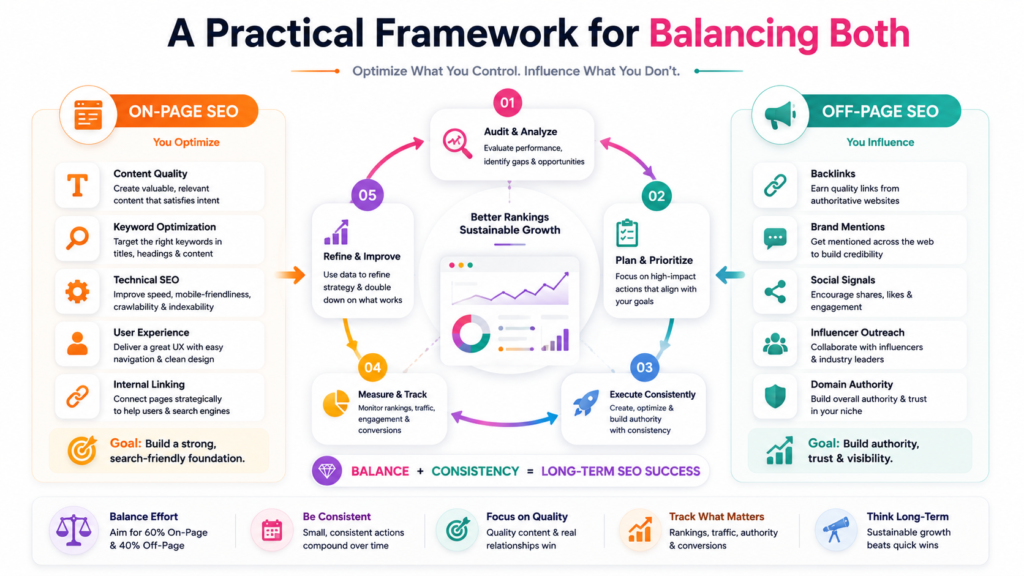
To get the results you need to find a balance between two things.
First you need to make sure the basics of your website are okay.
So you should check your title tags, headers, how fast your pages load. If you have any gaps in your content.
Do this before you start working on things.
Next you need to build a foundation of content.
This means you should publish content that’s complete and easy to understand and that fully answers what people are searching for.
Then you can start working on getting your website known by people.
You can do this by getting your name mentioned in articles writing guest posts and getting listed in local directories.
Do not try to take shortcuts.
You should also keep an eye on how your website’s doing.
Check how your keywords are ranking and how many other websites are linking to you and see if your content is up, to date.
Think of all these things as connected not as things.
Every months you should take a step back and see what you need to focus on.
What you need to do for your website will change over time so you need to check in and adjust your plan.
Common Mistakes to Avoid
Trying to get backlinks before fixing problems with the content on the page. Links going to a page that is not well optimized usually do not help with getting rankings.
Not paying attention to off-page SEO all. Some companies spend a lot on content. Never work on building signals that show their website is trustworthy. This limits how well they can rank for keywords.
Getting links from bad sources. This can break Googles rules about spam. Cause problems instead of helping with rankings.
Seeing on-page SEO and, off-page SEO as two things. They should be used together as a team not as tasks that are done alone.
FAQs
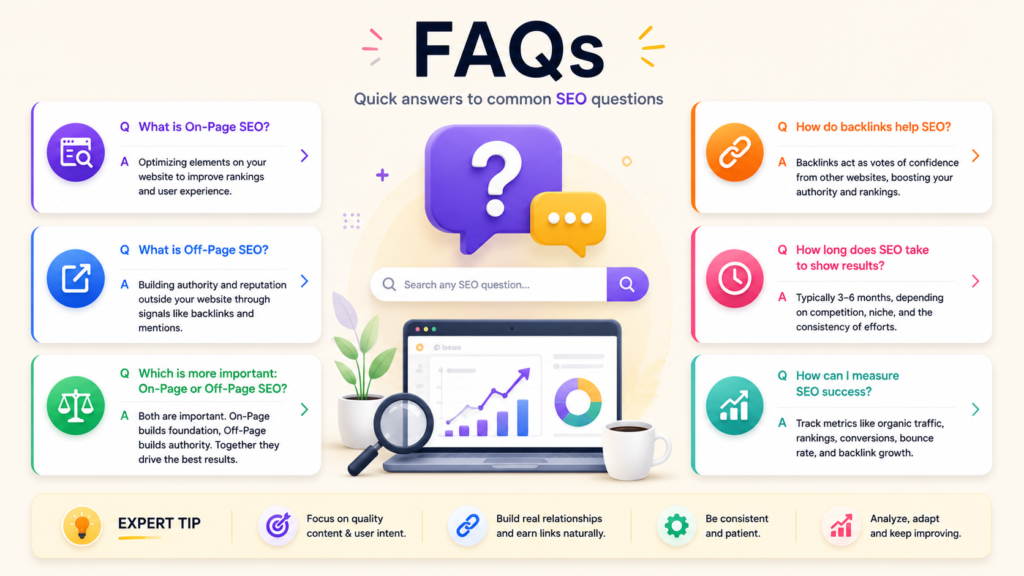
Is On-Page SEO more important than Off-Page SEO? No, it is not that easy. On-Page SEO is just a foundation while Off-Page SEO is a process built upon the foundation. But you need to remember that Off-Page SEO won’t bring you anything if there is no solid foundation under it.
How long it will take me to get some result from Off-Page SEO? Off-Page SEO is a time-consuming process especially when it comes to linking. You need to wait for several months before you see any results. Of course, it depends on what industry you belong to.
Is my website able to be successful with On-Page SEO alone? Yes, it is possible, but everything depends on the number of other websites competing with you in your niche. And in this case, you need to work on Off-Page SEO too.
What can I do to do Off-Page SEO right? First of all, you need to create some content, make relationships both within your niche and with other websites. Link buying and manipulation is not Off-Page SEO anymore. It is just not the right approach.
Conclusion: Actionable Takeaways
“Should we use on-page SEO or off-page SEO?” The answer to this question is neither “on-page SEO,” nor “off-page SEO,” as both SEO types have their place in marketing. First of all, one needs to perform on-page optimization to lay the necessary foundations for future SEO success. Secondly, one should build off-page authority via solid SEO practices.